Real Example: 2026 Tesla Model Y Sold at Salvage Auction for Half Price

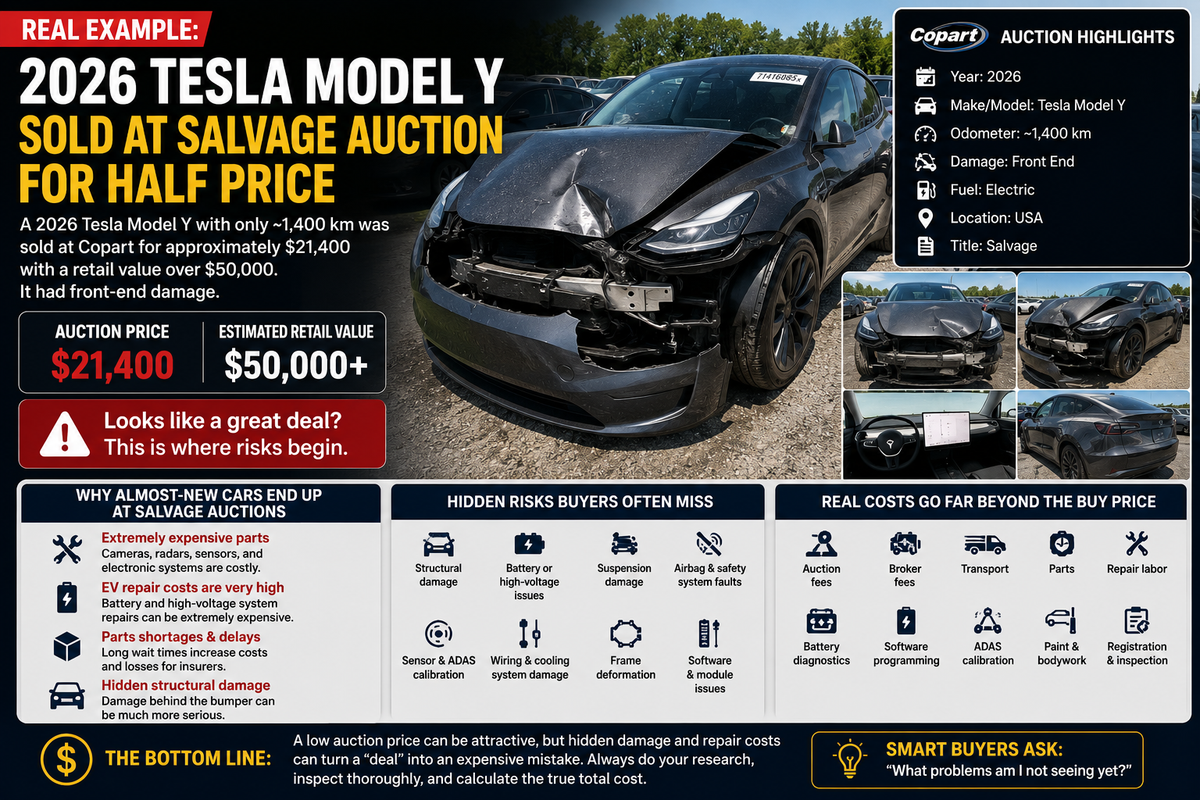
At first glance, it looked like an incredible deal.
A 2026 Tesla Model Y with only around 1,400 km on the odometer recently appeared at a Copart salvage auction. The vehicle had front-end damage but still looked surprisingly clean compared to the heavily wrecked cars most people associate with insurance auctions.
The retail value was estimated at over $50,000.
The final auction price?
Approximately $21,400.
For many buyers, listings like this create a powerful illusion:
“Why pay full price for a new Tesla if I can buy one for less than half the cost?”
And this is exactly where inexperienced buyers often make expensive mistakes.
Why Almost-New Cars End Up at Salvage Auctions
Many people assume insurance companies only total vehicles that are completely destroyed.
Modern vehicles — especially EVs — changed that reality.
Today, a relatively moderate accident can trigger extremely expensive repairs because modern cars contain:
- radar systems;
- ultrasonic sensors;
- cameras;
- battery protection systems;
- ADAS electronics;
- structural aluminum components.
In Tesla vehicles, even damage that appears “repairable” can quickly become financially impractical once diagnostics begin.
The Hidden EV Problem Most Buyers Ignore
Electric vehicles create a completely different repair environment compared to traditional gasoline cars.
A front-end collision may involve:
- cooling systems for the battery;
- high-voltage wiring;
- sensor recalibration;
- structural battery shielding;
- software safety restrictions.
Sometimes insurers total the car not because it is impossible to repair — but because the repair costs, labor, parts delays, and liability risks become too high.
That means a Tesla with relatively small visible damage can still carry enormous hidden expenses.
Auction Photos Never Tell the Full Story
This is one of the biggest traps for new salvage buyers.
Auction photos are designed to show the vehicle quickly — not to provide a professional inspection.
What buyers often fail to notice:
- bent structural supports;
- suspension damage;
- hidden battery-area impact;
- frame deformation;
- airbag system issues;
- damaged cooling components;
- wiring problems.
A car may look “lightly damaged” online while requiring tens of thousands of dollars in repairs underneath.
Why Cheap Salvage Teslas Attract So Much Attention
There is a reason these listings spread rapidly across TikTok, YouTube, Reddit, and automotive forums.
People see:
- low mileage;
- modern design;
- huge discount;
- expensive MSRP.
Emotionally, it feels like beating the system.
But experienced salvage buyers understand something important:
Purchase price is often the cheapest part of the project.
Real Costs Buyers Often Forget
The winning bid is only the beginning.
Additional costs frequently include:
- auction fees;
- broker fees;
- transportation;
- customs/export costs;
- replacement parts;
- battery diagnostics;
- software programming;
- ADAS calibration;
- paint and bodywork;
- registration inspections.
A “$21,000 Tesla” can quickly become a $40,000–50,000 project.
And in some cases, resale value still remains lower because the vehicle carries a salvage or rebuilt title history.
Why Vehicle History Reports Are Not Enough
Another dangerous misconception is assuming that a clean-looking history report guarantees transparency.
Some auction vehicles:
- have incomplete repair records;
- contain delayed insurance reporting;
- receive cosmetic repairs before resale;
- move between states or countries;
- develop battery issues later.
This is why experienced buyers combine:
- auction history;
- VIN reports;
- inspection records;
- repair estimates;
- independent inspections.
No single report tells the full story.
The New Reality of Salvage Auctions
The modern salvage market no longer consists only of old wrecked vehicles.
In 2026, insurance auctions increasingly contain:
- luxury EVs;
- nearly new SUVs;
- low-mileage performance cars;
- expensive technology-heavy vehicles.
For professionals, these cars can create opportunities.
For inexperienced buyers, they can become financial disasters disguised as bargains.
Final Thought
A nearly new Tesla selling for half price sounds exciting.
But in the salvage world, low prices usually exist for a reason.
The smartest buyers do not ask:
“How cheap is this car?”
They ask:
“What problems am I not seeing yet?”