Total Loss Title Explained: What It Means for a Used Car Buyer


Buying a used vehicle with a low price can look like a great opportunity. But when the vehicle history contains a Total Loss record, the price is only one part of the story.
A total loss designation means an insurance company determined that repairing the vehicle was not economically practical compared with its value before the damage. The exact rules and thresholds vary by state, so the same type of damage can result in different title outcomes depending on where the vehicle was insured and titled.
For buyers, the important question is not simply whether a car was declared a total loss. The important question is what happened to the vehicle afterward.
What Does Total Loss Mean?
A vehicle is generally considered a total loss when the estimated cost of repairing it reaches a level at which the insurer considers repair economically impractical.
This does not necessarily mean that the vehicle was completely destroyed.
A car can be declared a total loss because of:
- A major collision
- Flood or water damage
- Fire
- Hail or severe weather
- Theft recovery damage
- Structural damage
- A combination of repair costs and the vehicle's pre-loss value
The decision is based largely on economics. A relatively expensive vehicle may be repaired after substantial damage, while an older or lower-value vehicle can be declared a total loss after damage that appears less dramatic.
Total Loss vs. Salvage Title
These terms are related, but they are not exactly the same.
Total Loss is primarily an insurance determination.
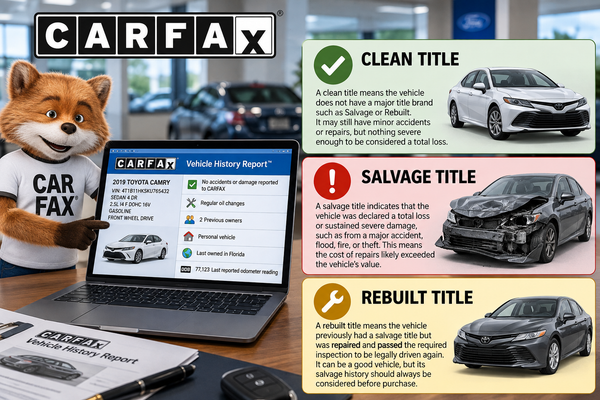
Salvage Title is a title designation applied under state rules after a vehicle has been classified as severely damaged or otherwise eligible for a salvage brand.
The typical sequence can look like this:
Accident or other damage → Insurance claim → Total Loss determination → Salvage title → Repair → Inspection → Rebuilt title
Not every vehicle follows exactly the same path. State requirements differ, and some vehicles may be dismantled, exported, sold for parts, or remain off the road.
Why a Total Loss Record Matters
A vehicle can look completely normal after repairs and still have a significant history.
Modern vehicles contain much more than visible body panels. A serious accident can affect:
- Frame or unibody structures
- Suspension mounting points
- Steering components
- Airbag systems
- Wiring harnesses
- Sensors and cameras
- Electronic control modules
- Battery and high-voltage systems on EVs
- Water-sensitive electrical components
Some problems may not appear during a short test drive.
This is why a history report should be treated as a starting point for inspection rather than as a substitute for a professional mechanical evaluation.
Why the Title History Should Be Checked Carefully
Title terminology is not completely uniform across the United States.
Different states have different rules for salvage, rebuilt, junk, flood and other branded titles. A vehicle can also move between states during its lifetime.
This makes it important to look beyond the current title document.
A buyer should compare several pieces of information:
- Current title status
- Previous title records
- Insurance loss information
- Accident history
- Auction records
- Odometer history
- Repair documentation
- Photographs of previous damage
- Inspection records
- VIN consistency
A single "clean" title today does not automatically explain everything that happened to a vehicle years earlier.
What Happens to a Total Loss Vehicle?
After an insurer declares a vehicle a total loss, the vehicle may be sold through an auction or transferred to another party.
Some vehicles are dismantled for parts. Others are repaired and eventually return to the road.
When a salvage vehicle is repaired and satisfies the applicable state inspection requirements, it may receive a rebuilt or reconstructed title. The exact terminology varies by state.
The important point is that rebuilt does not mean the vehicle never had serious damage.
It means the vehicle has gone through the applicable process to return to legal road use.
Total Loss Does Not Always Mean the Same Kind of Damage
One of the biggest mistakes buyers make is assuming that every total-loss vehicle has the same risk profile.
For example, a vehicle declared a total loss after hail damage is not necessarily comparable to a vehicle that suffered a severe collision or extensive flood exposure.
The cause of the loss matters.
Collision Damage
Look for evidence of:
- Frame or structural damage
- Airbag deployment
- Suspension damage
- Uneven panel gaps
- Replacement structural components
- Alignment problems
Flood Damage
Water exposure can create problems long after the vehicle has been cleaned and repaired.
Pay particular attention to:
- Corrosion
- Electrical connectors
- Wiring
- Modules
- Seat and carpet areas
- Unusual odors
- Water lines
- Repeated electrical faults
Fire Damage
Fire can affect wiring, plastics, sensors and structural components even when the visible damage appears limited.
Hail Damage
Hail may produce a very different repair profile, particularly when the primary damage is cosmetic rather than structural.
This is why the reason for the total loss is just as important as the title brand itself.
How to Check a Total Loss Record Before Buying
Start with the VIN.
A vehicle history report can help identify reported total-loss events, title brands, accidents, mileage records and other historical information. Government vehicle-history systems and state title records can provide additional information.
Auction records can also be particularly useful for vehicles that passed through salvage auctions.
When available, compare the current vehicle with older auction photographs.
The photos may reveal:
- The original impact location
- Missing airbags
- Broken suspension components
- Water damage
- Structural deformation
- Missing interior components
- Previous repair work
This comparison can sometimes tell a much more complete story than the current vehicle's appearance.
A Simple Example
Imagine a five-year-old vehicle with a pre-accident market value of $20,000.
An insurer estimates repairs at $15,000.
Even though the vehicle may still be physically repairable, the insurer may determine that repairing it is not economically practical under the applicable rules.
The vehicle is then declared a total loss.
Afterward, it may be sold at auction for a fraction of its previous value. A rebuilder purchases it, repairs the vehicle and completes the required inspection process.
Several months later, the same vehicle may appear for sale as a rebuilt vehicle.
The finished car may look excellent.
But its history has not disappeared.
The original total-loss event remains an important part of understanding what the vehicle is worth and what risks may remain.
What Should Buyers Ask the Seller?
Before purchasing a vehicle with a total-loss or rebuilt history, ask for documentation rather than relying only on verbal explanations.
Useful questions include:
- Why was the vehicle declared a total loss?
- Where was the damage located?
- Was the vehicle involved in a flood?
- Were airbags deployed?
- Was structural damage repaired?
- Who performed the repairs?
- Are repair invoices available?
- Are replacement parts documented?
- Was the vehicle inspected after repairs?
- Can the seller provide previous auction photographs?
- Can the VIN history be reviewed independently?
A seller who cannot explain the vehicle's history clearly should not be treated the same as a seller who can provide detailed documentation.
The Bottom Line
A Total Loss record is an important warning in a vehicle's history, but the label alone does not tell the entire story.
The buyer needs to understand:
why the vehicle was totaled, what damage occurred, how it was repaired, how the title changed, and what documentation supports the repair.
For a more detailed examination of total-loss and title-history records, see our complete analytical guide:
Total Loss Title: Complete Analytical Overview — read the full guide on CarFaxForSale
Checking the VIN before buying gives the buyer an opportunity to investigate the vehicle's past before committing money to its future.