Why You Should Check a Vehicle’s History Before Buying a Used Car

Buying a used car is often a compromise between price, condition, mileage, and age. A vehicle can look excellent in photos, drive well during a short test drive, and still have a past that changes whether it is worth buying.
That is why checking a vehicle’s history should be one of the basic steps before purchasing a used car.
A history check cannot tell you everything about a vehicle, and it should never replace a physical inspection. But it can help you identify important questions before money changes hands.
Here are some of the most important things a vehicle’s history can reveal.
1. The Car You See Today Is Only Part of the Story
A used car is the result of everything that happened to it before it reached the current seller.
Two cars of the same year, model, and mileage can have very different histories.
One may have been regularly maintained, driven by the same owner for years, and sold with consistent records.
The other may have changed owners several times, been involved in an accident, appeared at an auction, or accumulated mileage that does not match the number currently displayed on the dashboard.
From the outside, those vehicles may look almost identical.
Their histories are not.
That is why evaluating a used car only by its current appearance can be misleading.
2. Accident History Can Change the Way You Evaluate a Car
An accident in a vehicle’s past does not automatically mean you should walk away.
Cars are damaged and repaired every day. A properly repaired vehicle can continue to provide years of reliable service.
The more important questions are:
How serious was the damage?
When did it happen?
Was the vehicle repaired correctly?
Does the asking price reflect its history?
A minor parking incident and a major collision are very different events, even though both may appear somewhere in a vehicle’s records.
If you discover previous accident information, use it as a reason to inspect the relevant areas more carefully.
Look for inconsistent panel gaps, differences in paint finish, signs of structural repair, replaced components, or other evidence that deserves professional attention.
The history gives you a clue. The physical inspection helps you understand what that clue means today.
3. Mileage Records Can Reveal Important Inconsistencies
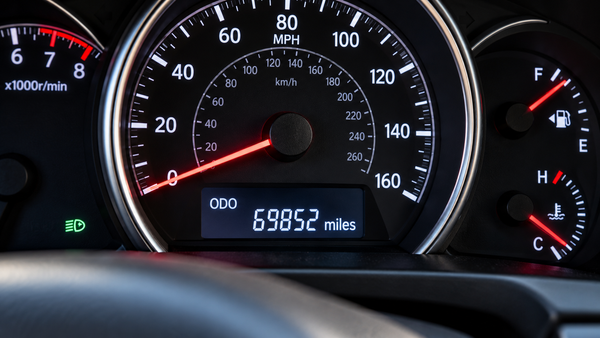
Mileage has a major influence on the perceived value of a used vehicle.
That also makes the odometer one of the areas buyers should examine carefully.
Suppose the historical mileage looks like this:
2020 — 41,800 miles
2021 — 57,400 miles
2022 — 72,900 miles
2023 — 88,600 miles
Current odometer — 61,200 miles
Something clearly needs an explanation.
That does not automatically prove odometer fraud. Data-entry errors happen. Instrument clusters can be replaced. Miles and kilometers can occasionally be confused.
But a significant mileage reversal should never simply be ignored.
A better approach is to compare several sources: previous mileage records, maintenance documents, inspection records, the current odometer, and the physical condition of the vehicle.
When all of them tell the same story, confidence increases.
When they contradict each other, investigate further.
4. Title History Can Matter More Than the Paint
A shiny exterior does not tell you how a vehicle has been classified in the past.
Depending on the vehicle and jurisdiction, its history may include important title-related information.
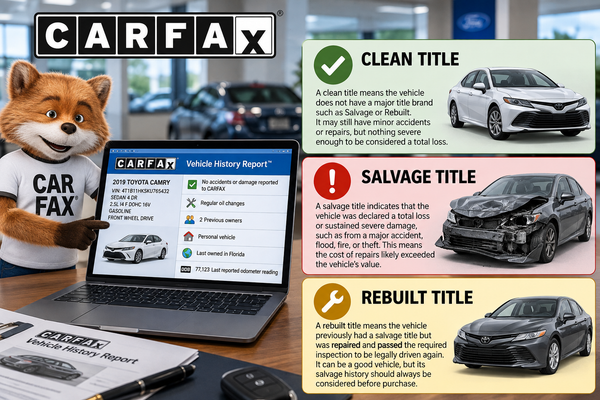
Terms such as clean title, salvage, rebuilt, flood, or other title brands can significantly change how a buyer should approach a vehicle.
For example, a rebuilt vehicle may look completely normal today. But knowing that it previously received a salvage designation gives you important context.
It may affect the price you are willing to pay, the inspection you request, financing or insurance considerations, and eventually the vehicle’s resale value.
The important lesson is simple:
Current condition and historical status are two different things.
You should understand both.
5. Ownership History Provides Useful Context
The number of previous owners is not automatically good or bad.
A one-owner car can be neglected. A three-owner car can be meticulously maintained.
Still, ownership information can provide context.
Frequent changes of ownership over a short period may make you want to investigate further. Long periods with one owner may make service records easier to follow.
Ownership changes can also help explain other events in the timeline.
For example, a change of state, registration, mileage record, auction appearance, and new owner occurring within a relatively short period may form part of the same transaction.
Instead of looking at each record separately, try to understand the vehicle’s history as a timeline.
6. Service Records Help You Understand How the Vehicle Was Used
Maintenance records can be particularly useful because they add context to mileage and ownership information.
Regular oil changes, scheduled maintenance, brake work, tire replacement, inspections, and other recorded services can help build a picture of how the vehicle was maintained.
But there is an important limitation.
A missing service record does not necessarily mean the service never happened.
Independent garages, private mechanics, and owners performing their own maintenance may not report information to the databases you are checking.
For that reason, service history should be treated as one piece of evidence rather than a complete maintenance diary.
Ask the seller for receipts and maintenance documentation whenever possible.
7. Auction Records Can Tell You More About a Vehicle’s Past
Some used vehicles have previously appeared at wholesale or salvage auctions.
That information can sometimes be particularly valuable because an earlier auction record may provide context about the vehicle at a specific point in its life.
If photographs or descriptions from an earlier sale are available, compare them with the vehicle you are considering today.
A car that now appears perfectly repaired may once have looked very different.
Again, an auction appearance does not automatically make a vehicle a bad purchase.
The goal is simply to know what you are buying.
8. A History Report Can Help You Ask Better Questions
Perhaps the biggest benefit of checking vehicle history is not finding a dramatic warning.
It is knowing what to ask.
Instead of asking the seller:
“Is there anything wrong with the car?”
you can ask much more specific questions:
“Why does the mileage recorded in 2023 exceed the current odometer reading?”
“Do you have documentation for this repair?”
“Can you explain this title change?”
“Was this damage repaired before you purchased the vehicle?”
Specific questions are much more useful than general ones.
They also make it easier to compare the seller’s explanation with the available records.
9. What a Vehicle History Check Cannot Tell You
Vehicle-history information is useful, but it has limitations.
Not every accident, repair, maintenance visit, or ownership event is necessarily reported to every database.
A clean-looking history should therefore never be interpreted as a guarantee that a vehicle has never been damaged or had problems.
This is why a strong used-car buying process combines several steps:
Vehicle history → physical inspection → test drive → documentation → independent pre-purchase inspection
Each step answers different questions.
Together, they provide a much clearer picture than any one source alone.
10. Check the VIN Before You Check the History
Before ordering or reviewing any vehicle-history information, verify the VIN itself.
Compare the VIN shown on the dashboard with the VIN on the vehicle documents and other identification locations available on the car.
A typical VIN contains 17 characters on modern vehicles.
Even a very useful history report becomes irrelevant if it belongs to a different vehicle because one character was entered incorrectly.
Take a photo of the VIN and enter it carefully rather than relying on memory.
A Better Way to Think About Vehicle History
A vehicle-history check is not about finding the perfect used car.
Perfect histories are rare, particularly as vehicles become older.
Instead, the goal is to reduce uncertainty.
You want to understand whether the vehicle’s mileage, ownership, title information, maintenance, reported incidents, and current physical condition make sense together.
A previous accident may be acceptable.
High mileage may be acceptable.
Multiple owners may be acceptable.
Even a complicated history may be acceptable at the right price and after the right inspection.
What should make you cautious is a history that doesn't match the vehicle or the seller’s explanation.
Before You Buy
Before committing to a used vehicle, take a few minutes to research its VIN and review the available history.
Services such as CheapVINReport can be used as part of that research process.
Then compare what you find with the vehicle itself.
Check the mileage. Review the documents. Ask about previous damage. Look at maintenance records. Take a proper test drive. And for a significant purchase, consider having the vehicle inspected by an independent mechanic.
A vehicle history report should not make the buying decision for you.
It should help you make that decision with more information.